
About the Journal
Culture Crossroads is an international peer-reviewed journal published by the Institute of Arts and Cultural Studies of the Latvian Academy of Culture. The goal of Culture Crossroads is to develop and expand theoretical and methodological approaches to the research of art and creativity with emphasis on the potential of a variety of disciplines and interdisciplinarity. The main focus of the publication is on the interaction of cultural, artistic and creative processes as well as the synergy between them and other domains of national economy, politics and social life. It is targeted on the most topical issues and discussion points in culture studies and arts. The publication is open to research in the fields of ethnology, theory of culture, semiotics, cultural anthropology, museology, cultural heritage, management of culture, sociology of culture and art, cultural economics (including creative industries), cultural politics, audio-visual art, performing arts, dance, theory of literature, musicology, law, linguistics, or other domains of culture studies and arts.
Culture Crossroads is indexed in: SCOPUS; EBSCO (Humanities Source Ultimate); ERIH PLUS; ULRICH'S; Central and Eastern European Online Library (CEEOL).
According to the latest data from Scimago, Culture Crossroads was in the second quartile in the thematic area “Arts and Humanities (miscellaneous)” in 2023.
Current Issue
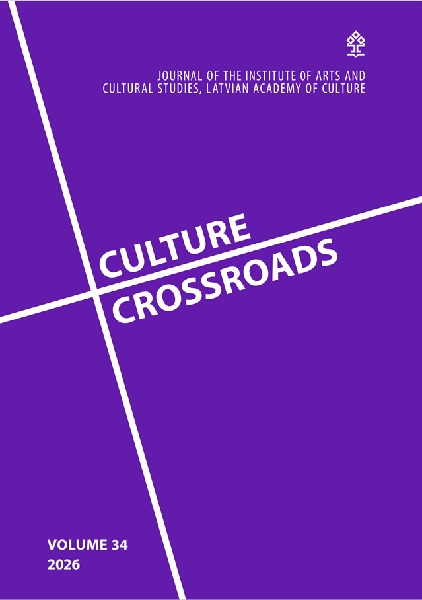
Time represents one of the most universal dimensions characterising human experience. Meanwhile, it is a culturally differentiated phenomenon. Every civilization, religious tradition, philosophical system, and social order develop their own understanding of binary phenomena relating to time and interpreting it – continuity and change, memory and anticipation, cyclical return and historical progression. These differing temporal frameworks form the grounds that enable the cultures to organize their individual experiences, as well as collective life.
This special issue of Cultural Crossroads, The Grammar of Time: Ontologies and Practices Across Cultures contains articles by scholars representing diverse intellectual traditions and geographical contexts. Here, they explore the ways how time is conceptualized, experienced, represented, narrated, and regulated across cultures. These contributions approach temporality from a wide spectrum of views that encompasses philosophy, religious studies, linguistics, literary criticism, media studies, political thought, anthropology, and visual culture.